
Spider-Versus
SPIDER-VERSUS
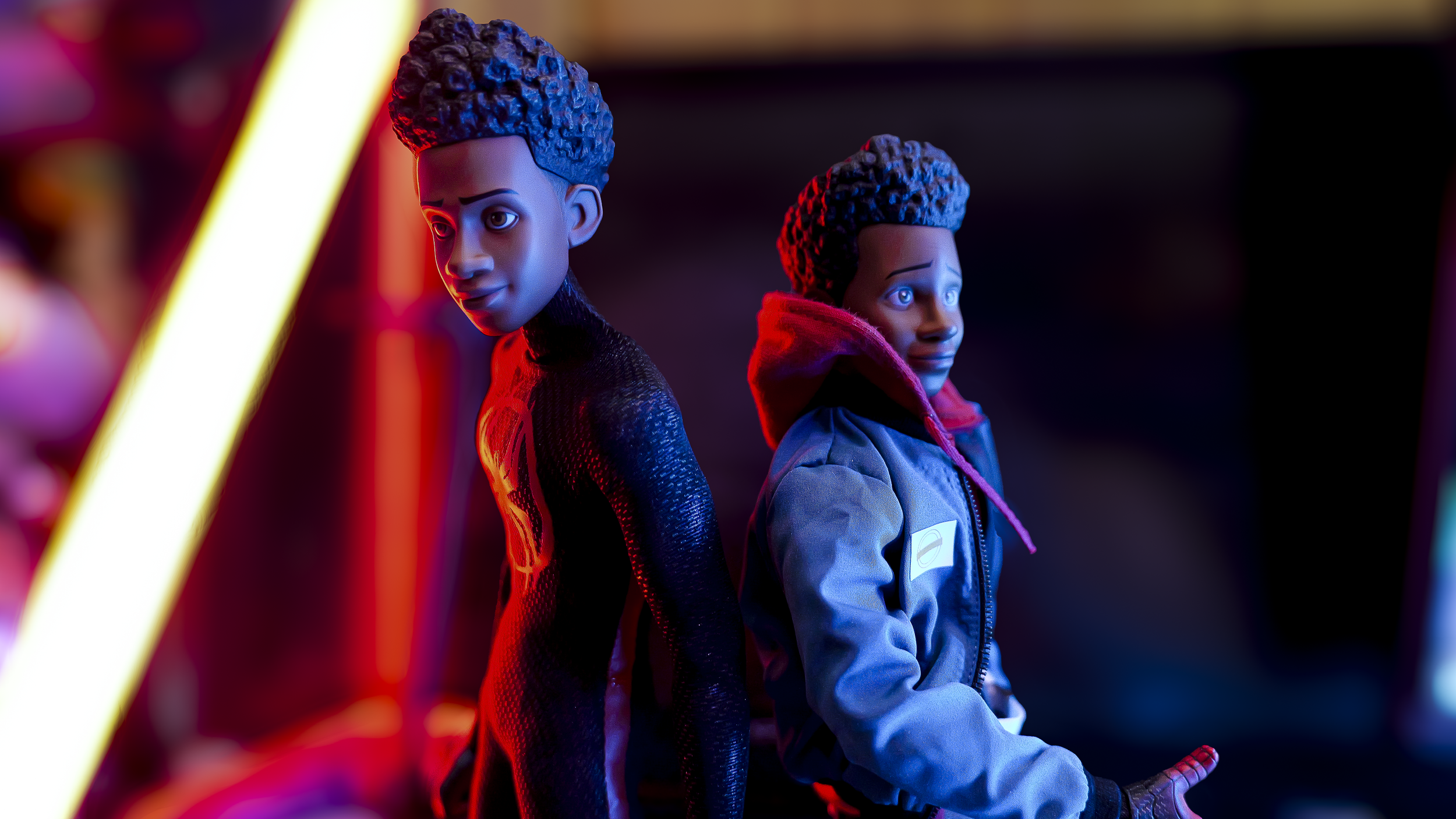
Spider-Versus was one of the first test shoots I did while getting comfortable with the Panasonic Lumix S5IIX.
I still don’t have a dedicated setup for toy photography, so everything was photographed directly on my work desk using lights I had purchased for photography and videography - which, at the time meant our Wild Dogs Beyblade projects. The goal was fairly simple, I wanted to experiment with different lighting combinations, see how the Lumix handled blacklight and saturated color, and get a better sense of how much distance I needed between the camera and multiple figures to keep everything I wanted in focus.
It also gave me an excuse to photograph Miles Morales.
Several Miles Moraleses, actually.
There was never a full story planned for the shoot. I mostly started with the idea that I happen to own a Spider-Verse’s worth of Miles Morales figures, so let’s put them together. As the session continued, though, a loose Spider-Verse story began forming around the images.
The sequence roughly begins with the Miles from Across the Spider-Verse, apparently pulled out of his own reality during a confrontation with the Spot. He arrives in a strange nexus space and encounters the younger version of himself from Into the Spider-Verse.
From there, the Miles population grows as the two eventually encounter their videogame counterpart: Miles Morales.
In the meantime, elsewhere Miguel O’Hara crosses paths with Miles G. Morales.
It’s a brief section of the test shoot, but beyond the bright colors to test in the blacklight, that pairing was loosely inspired by fan theories surrounding Miguel, The Prowler and Spider-Man.
Eventually, Miguel catches up with the assembled Spider-Men and confronts the Miles he still considers an anomaly.
Then Miguel inexplicably disappears from the story…it was never a particularly strict narrative.
In Miguel’s place, Spider-Punk (Hobie Brown) and Miles G. Morales enter the picture, with Hobie appearing to take Miles G. under his wing. The original Miles is initially wary of his alternate counterpart, but the tension gives way to a fist bump and an uneasy sense that maybe this version of Miles isn’t so bad after all.
The shoot ends with a few more atmospheric images of Miles G. preparing to leave his own mark on the strange little nexus they’ve all stumbled into.
From a technical perspective, Spider-Versus was reassuring. The Lumix required surprisingly little work to produce images I liked. Most of the editing was relatively light, or frankly, in many cases non-existent outside of cropping in a 16:9 Ratio. This shoot helped me better understand the focus distance and depth of field for our starting Lumix Lens (20-60, 0.15m/0.49ft[min]). I also used this shoot to explore how strongly colored lighting would translate through the camera, something that, at the time I wanted to experiment and play around with for our Beyblade Training videos.